
What the Land Remembers: Material Memory in Boundary Layers Exhibition
By Kelsey L. Smoot
March 31, 2026
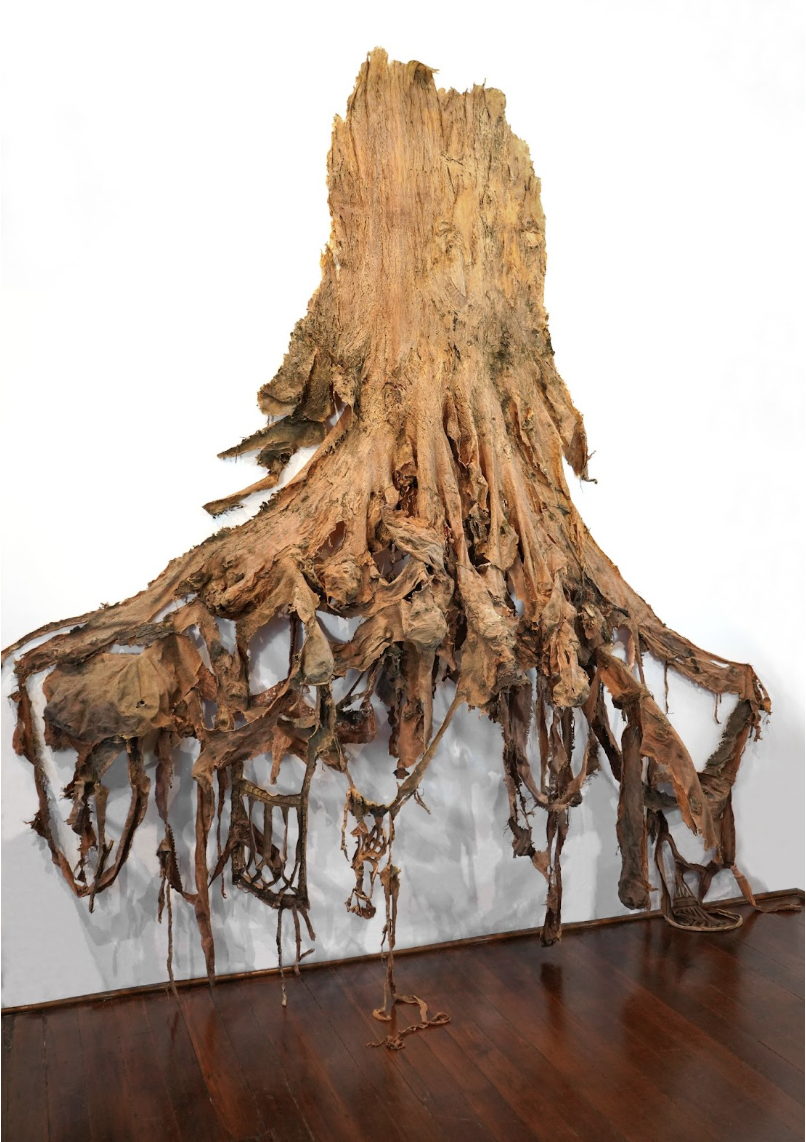
Carlie Trosclair, Echoes beneath, 2025, Latex, soil & bark remnants, residual fibers, 10 x 16 x 4 ft. Photograph courtesy of Whitespace Gallery.
Boundary Layers, the unfurling, earth-hued Atlanta exhibition curated by Heather Bird Harris, features work that quietly but insistently troubles the seams between environmental and industrial material conditions. In the show’s description, this tension is named with precision: “Each artist’s practice attends to the subtle shifts that occur at these thresholds, where surfaces act not as limits but as passages between bodies, elements, and realms of living, troubling which boundaries are real and imagined.” What the show makes clear, however, is that these boundaries are not only conceptual. They are chemical, historical, infrastructural, and bodily.
As my friend and I made our way toward Susan Bridges’ Whitespace for the opening, a small but formidable gallery tucked behind a residential Atlanta neighborhood, the night already felt auspicious. A fire crackled in the courtyard as attendees arrived, huddling together closely beneath the warm glow of string lights. A bartender armed with spiked cider and poem scraps offered steaming libations before we stepped inside. The gallery itself, consisting of rustic-industrial rooms and outdoor spaces stitched together by a central courtyard, is aptly named. Movable white panels offer a deliberate contrast to the brick, wood, and concrete that form the building’s skeletal encasement, emphasizing permeability rather than enclosure.
That porosity is not incidental. Harris has spoken about allowing the site itself to guide the exhibition’s formation, insisting on “a plan with wiggle room” —one responsive to space rather than imposed upon it. Throughout Boundary Layers, materials seem to listen; they are indelibly shaped by the ongoing rhythms of ecosystems.
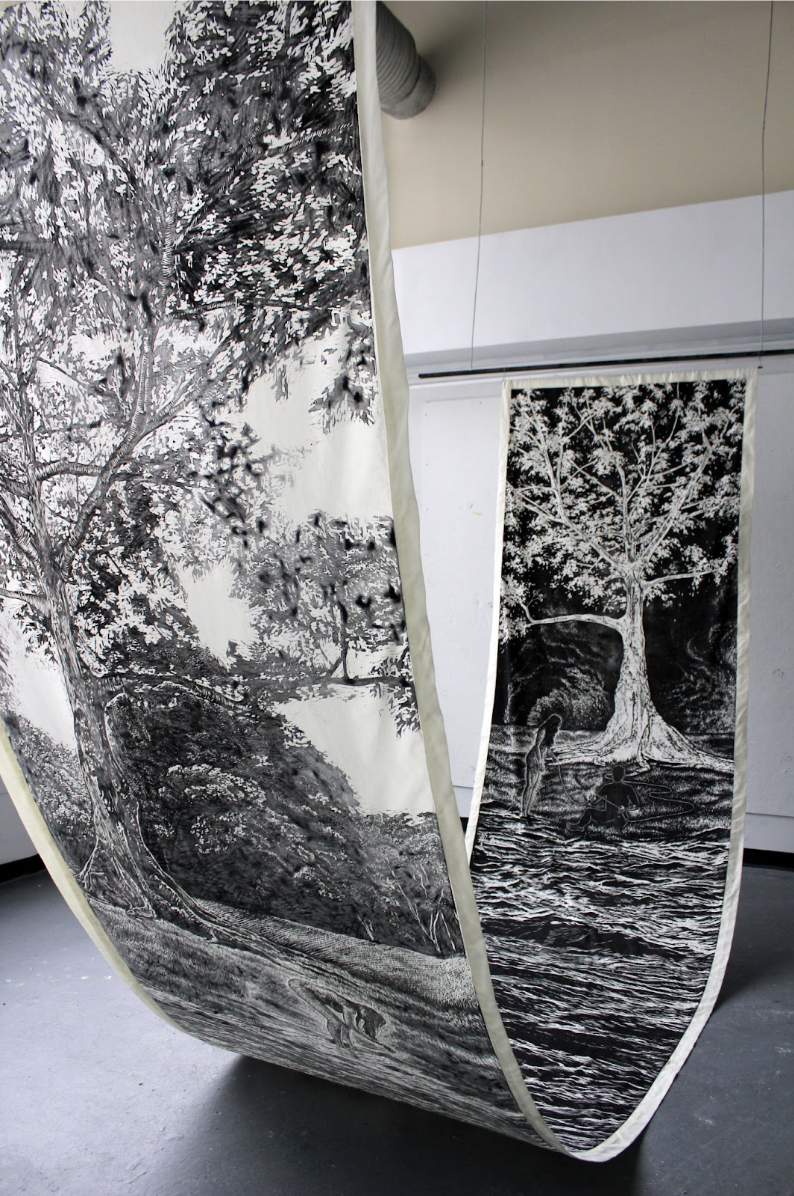
Elisa Dore, Circular Migration, 2025, Woodcut on muslin, 4.5 x 25 ft. Photograph courtesy of Whitespace Gallery.
The first room I entered was unmistakably aqueous. Elisa Dore’s Circular Migration, a dazzling large-scale muslin print of a watery scene, swept across the space, bisecting the room, while nearby works echoed its cool tonalities. Here, water is less barrier and more bridge. Several artists in the exhibition work directly with site-specific water sources, allowing chemical composition, light cycles, and time to shape the final image.
To my left, a cluster of small glass bottles immediately drew me in. Potions, I thought, or reliquaries. Madeline Kelly’s Will We Remember from Where We Come? features typed labels that adorn each vial: tears; cypress cathedral – soft morning rain; Tornado Watch Wee Hours. The effect was intimate and disarming. These vessels emerge from an archive of lived memory and shared history. Some contain water gathered from specific sites; one holds literal tears, carried for years in a purse before finding its place in the gallery. The bottles function as emotional cartographies, mapping grief, weather, and time through accumulation rather than representation. The prominence of Louisiana-based artists in Boundary Layers traces back to Harris’s time living in New Orleans, where long-standing relationships formed through shared material concerns—water, extraction, endurance—continue to resonate in her curatorial practice.
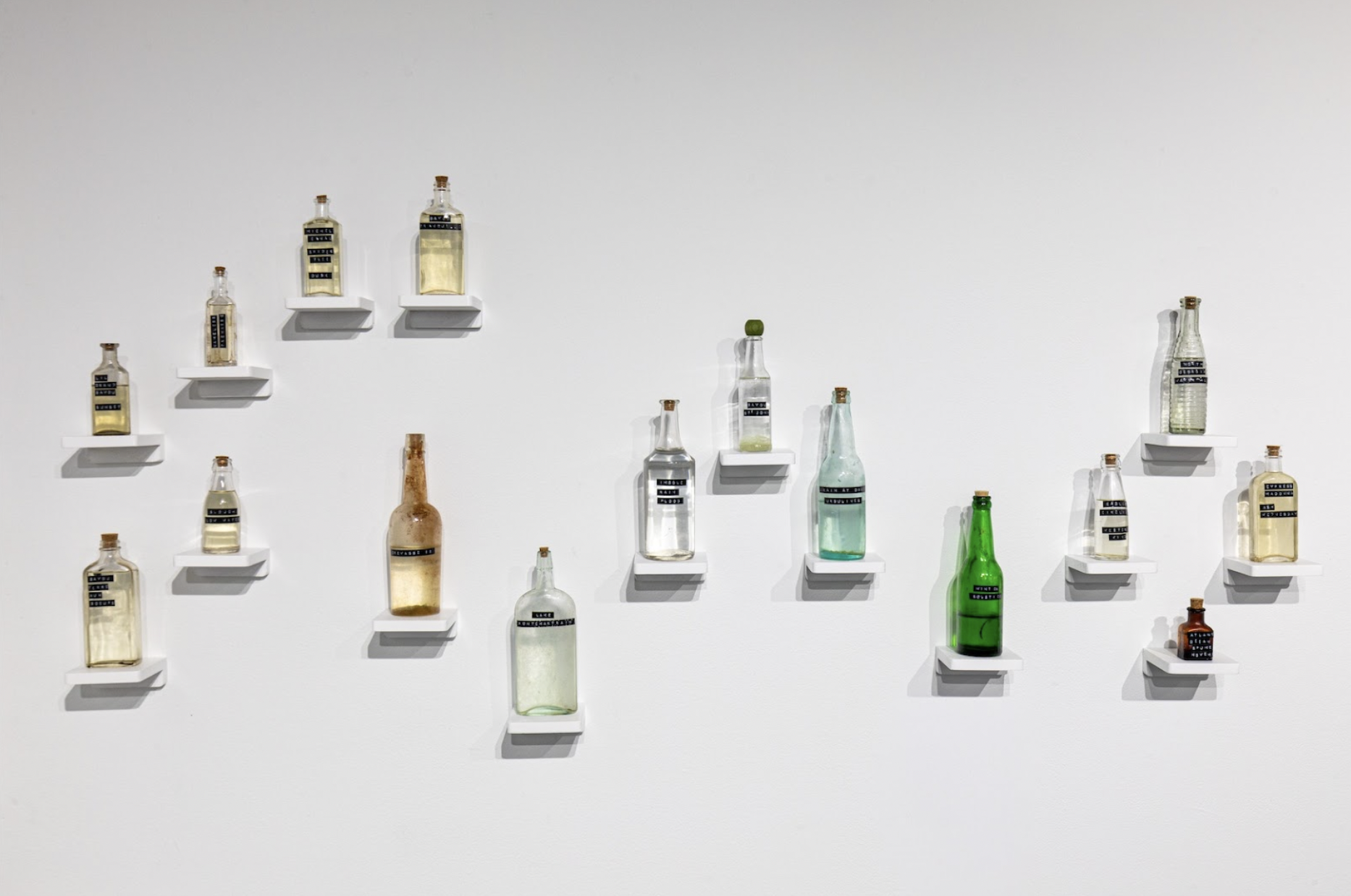
Madeline Kelly, Will We Remember from Where We Come?, 2025, Glass bottles and living water, installation, 30 x 40 in. Photograph courtesy of Whitespace Gallery.
Moving into another room, I was arrested by the sight of a sprawling latex tree cascading down the sole wood-paneled wall. Carlie Trosclair, the New Orleans-based artist behind the piece, spoke to me with vivid, sweeping gestures. She described her process of painting latex onto the tree—its roots, its surrounding balustrades, a boulder, the underbrush, the mangled hearth of the bayou. She spoke of structures of home that center her work, of environmental and constructed forms as “ghostly, luminous vessels.” One of her other projects in the show, she explained, features cypress knees, regenerative plant components that, even if the landscape changes, will always regrow because they “remember that the water was once there.” Harris has noted that many of the works in Boundary Layers are less interested in preservation than in what she calls “environmental memory,” the quiet insistence of places that refuse to forget what they have been.
This tension between domination and endurance recurs throughout the exhibition. Hannah Chalew’s Christmas Tree and Study for Christmas Tree entwine oil pipe infrastructure with resurrection ferns and oak forms, drawing from Louisiana’s petrochemical corridors. One sculptural, the other rendered on handmade paper using oak gall ink, the works function as companions rather than competitors. Chalew, also New Orleans-based, describes resurrection ferns as capable of losing up to ninety percent of their water and still regenerating. Survival, here, is neither romantic nor abstract; it is an adaptive strategy.
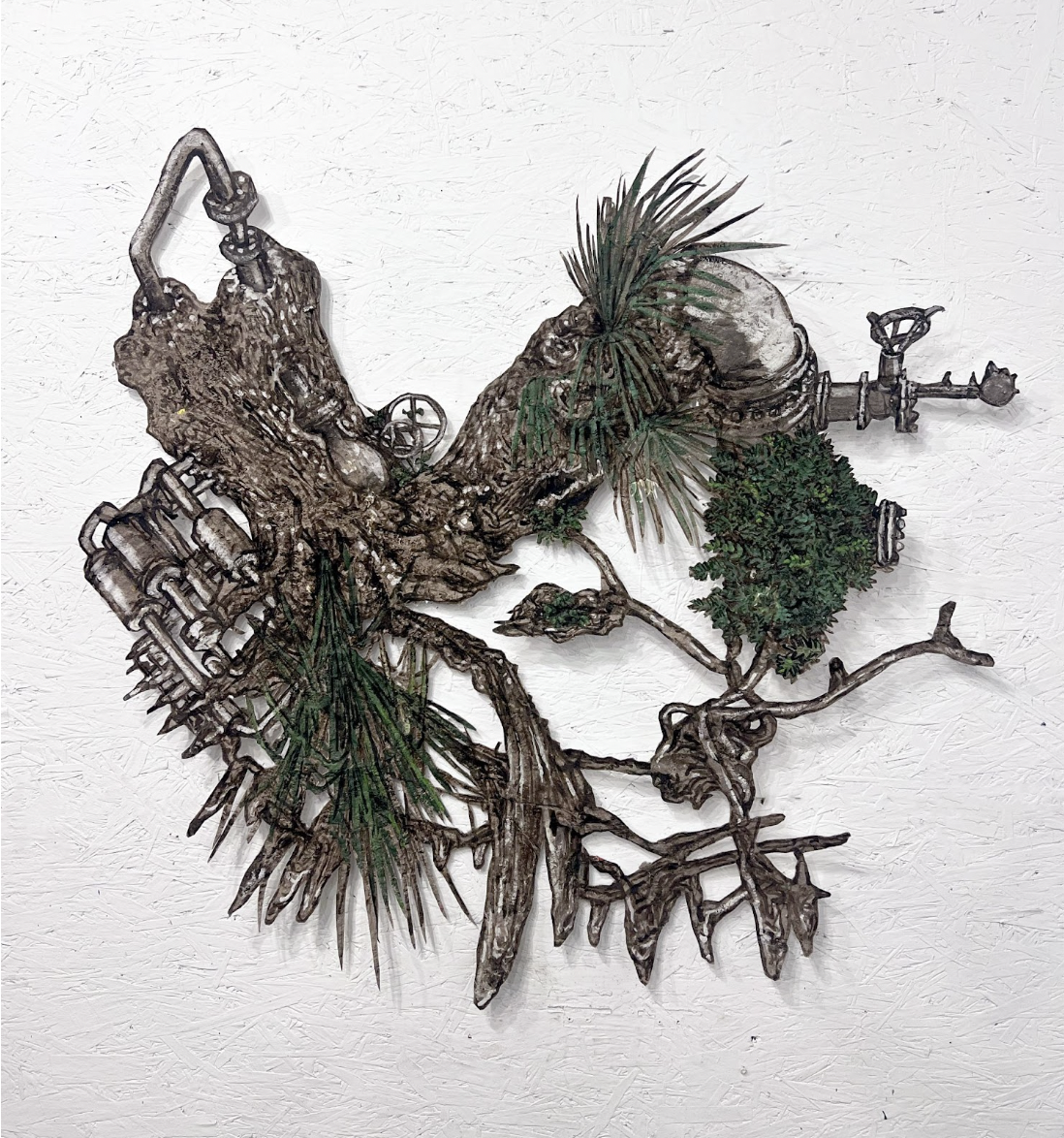
Hannah Chalew, Study for Christmas Tree, 2025, Ink made from fossil fuel pollution, iron, oak gall and sheetrock on paper made from sugarcane and disposable plastic waste ("plasticane"), 43 x 43 in. Photograph courtesy of Whitespace Gallery.
Another vessel in the exhibition holds both memory and water. a whisper, a blessing, a shout!: the fire horse by Zipporah Camille Thompson features, in part, a ceramic shout pot sitting quietly in the space, its presentation altered by the gestures of viewers. During the exhibition’s opening, Harris noticed visitors dropping pennies into the pot, an unprompted act that transformed it into something like an offering. Historically, shout pots were used in Hush Harbors; enslaved people would sing or cry into water-filled vessels to muffle sound, creating a threshold where expression could exist without detection. Here, the pot functions as both pressure release and receptacle, a site where grief, frustration, and hope are deposited rather than resolved. That visitors instinctively engage it suggests how quickly ritual re-emerges when given even the smallest opening.
Elsewhere, Elizabeth M. Webb’s porcelain burnout works confront boundaries of race, ownership, and fragility. In her process, legal land deeds are submerged in porcelain slip and fired in a kiln, the paper incinerated from within, leaving behind a brittle shell. Porcelain, long prized for its strength and purity, is made deliberately fragile. The fractures produced by heat and pressure are not flaws but evidence, revealing how constructs like whiteness, property, and value are materially made and unmade.
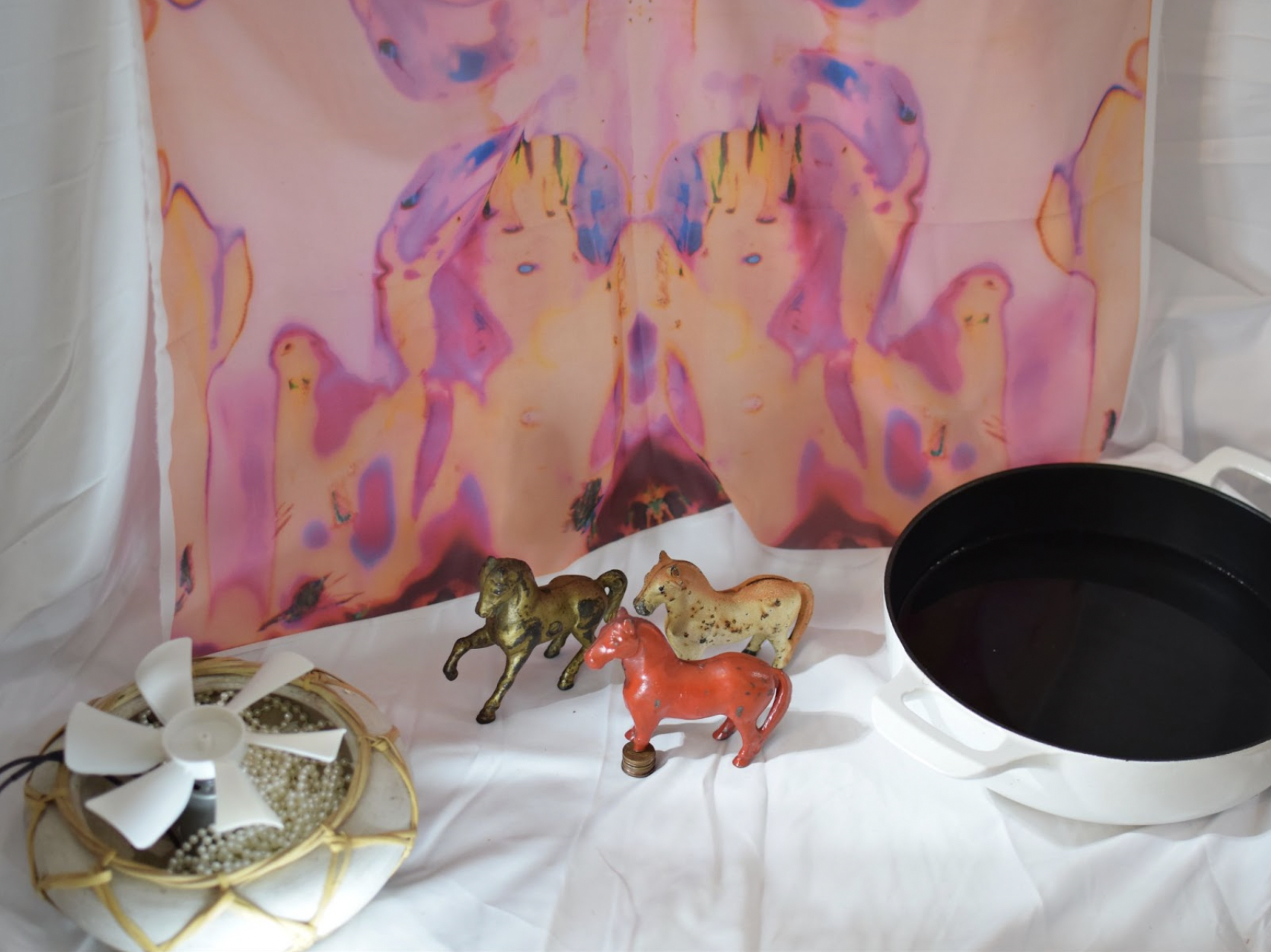
Zipporah Camille Thompson, a whisper, a blessing, a shout!: the fire horse, 2026, rv fan, artist-cast iron tile, vintage cast iron horse banks, cast iron pot, wolf moon lunar water, lucky pennies, cement, seashell, pressure print transfer onto chiffon, 28 x 42 x 18 in. Photograph courtesy of Whitespace Gallery.
The exhibition’s attention to scale further unsettles fixed perspectives. Harris shared with me how materials help “readjust our time literacy to a geologic sense.” Sachi Rome’s vast and kinetic canvas Cartwheel Skies depicting abstract portals, oceans, and Michelle Laxalt’s walk sculpture (water oak)–a small, delicate tree sprig–carry equal weight here, reminding viewers that power does not correlate neatly with size. Disorientation conjures a method, inviting viewers to zoom out, to recognize themselves as bodies moving in systems far older and larger than human design.
Late in the evening, a flute performance by the rivetingly talented Kate Burke filled the gallery with breath. The sound felt ancient, swampy, ethereal. The flute, Harris explained to me afterward, is uniquely capable of vibrato because it is a direct translation of breath, “like singing through an instrument.” In a show preoccupied with boundary layers, breath becomes its own threshold, the point where inside and outside meet.
Throughout the night, I found myself in thrilling conversation with artists who seemed as eager to engage big ideas as they were to discuss their individual practices. The gallery hummed with attention and care. As I walked back to my car, images lingered: the latex tree, the watery print, the vial of tears perched like a talisman. Boundary Layers does not offer resolution. Instead, it honors entanglement, mess, and endurance.
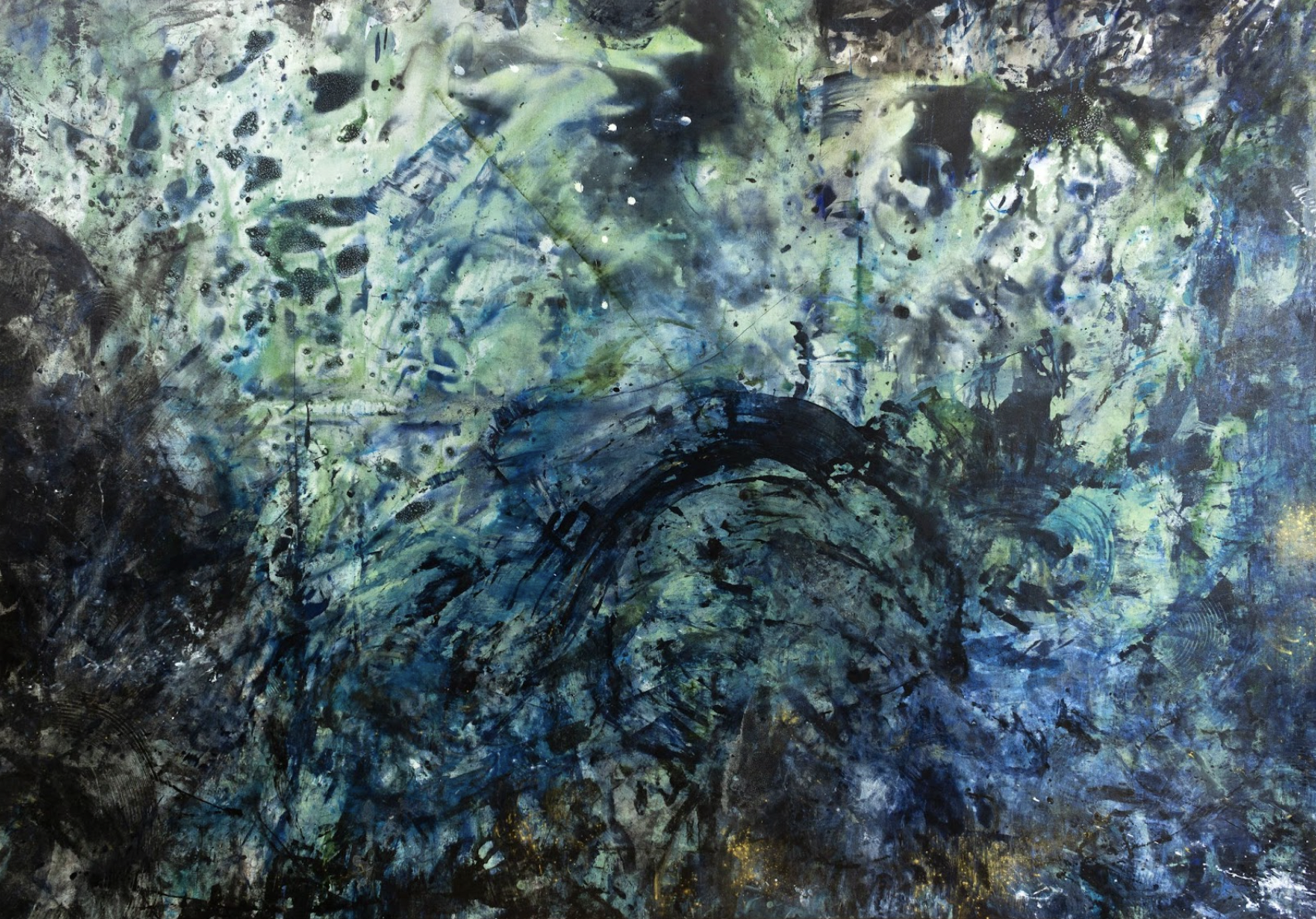
Sachi Rome, Cartwheel Skies, 2024, acrylic, mica powder and diamond dust on canvas, 60 x 74 in. Photograph courtesy of Whitespace Gallery.
Boundary Layers was on view at Whitespace Gallery in Atlanta, Georgia from January 23 through March 7, 2026. 814 Edgewood Ave NE, Atlanta, GA 30307.