
Raven Halfmoon Speaks in Red
By Sophia Greeson
March 31, 2026
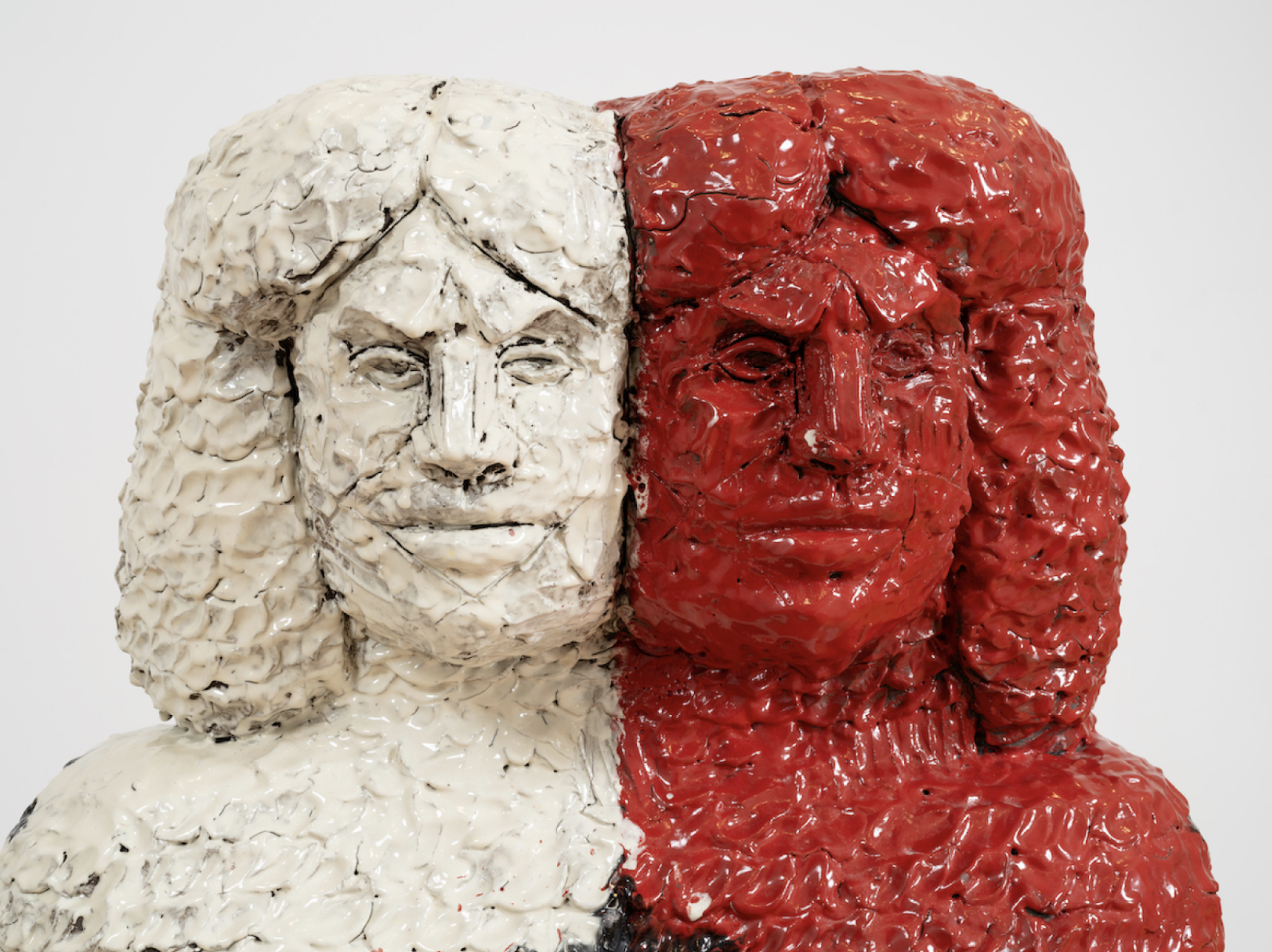
Raven Halfmoon, Tsu’-Cus Iya’y? I (Star Sister I) (detail), 2022, Stoneware, glaze, 55 x 38 x 23 inches. Collection of Mark McDonald and Dwayne Resnick, Courtesy of Ross + Kramer Gallery. Image courtesy of Bemis Center for Contemporary Arts. Photography by Colin Conces.
To speak in red is to speak in a language of contradiction. Red is for blood and for blush, a dialectic of tension: vitality and injury, dominance and shame, kinship and insurrection. Red erupts. In the United States, the color is especially loud. Yes, she’s the color of our flag, but she's also on the ground: the iron of injured land, the seeds of bodies returning to the earth too soon. Without bravery, many have turned to her to answer their prayers. But the wisest know: red is both a weapon and a wound.
It is not easy to speak from that thrashing place where red resides. Nevertheless, it is from this roil that Raven Halfmoon sources her latest exhibition, Flags of Our Mothers, where the color is an ever-present verse. The force of pigment leads me into the exhibition— the air is weighted by it. Large swathes of crimson, charcoal, and cream hang in space, the skin of monumental ceramic figures. Familiar motifs present themselves, simple stars and stacks. You can see how these bodies were made: fat coils laboriously worked together, smeared with fingers, palms, and thumb. The work retains the impact of its creation, the repetitive process of snake laid upon snake. Like the vestiges of history, clay circles itself before pulling away. Red is the trace of this recurrence, a reminder that the past is always a return.
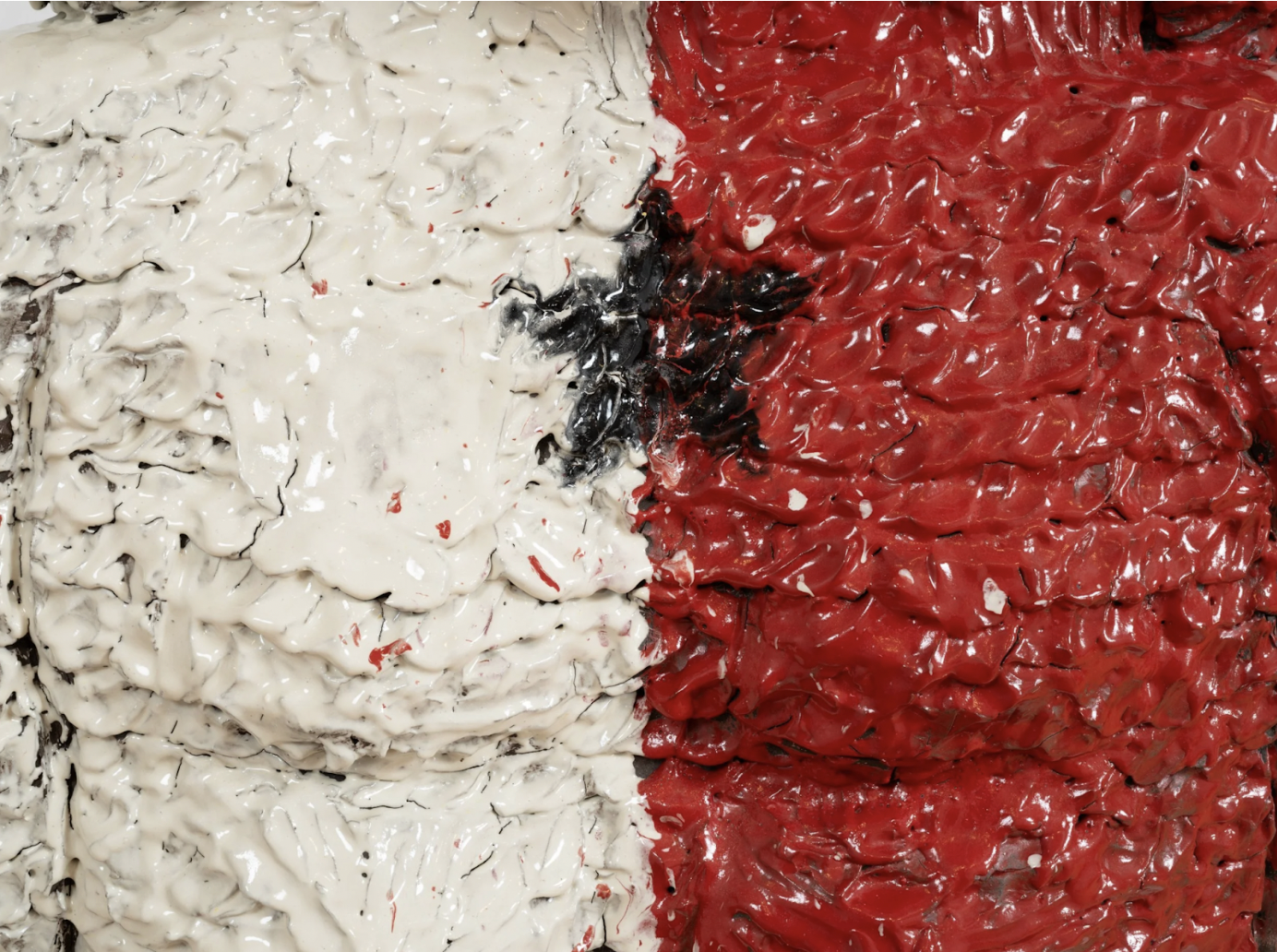
Raven Halfmoon, Tsu’-Cus Iya’y? I (Star Sister I) (detail), 2022, Stoneware, glaze, 55 x 38 x 23 inches. Collection of Mark McDonald and Dwayne Resnick, Courtesy of Ross + Kramer Gallery. Image courtesy of the artist.
Halfmoon’s sculptures are new American monuments possessing a vitality absent in the established monument tradition. Each of her figures has an unmistakable presence, and I feel them teaching me about integrity, about how to be a woman who extends beyond her body instead of shrinking into it. Halfmoon’s work venerates her Caddo matriline. Red is her partner in this act of devotion, giving form to memory, inheritance, and accusation. In one sculpture, red is power; in another it is familial love; in another yet, under the bloodshot eye of a dying horse, it is sickeningly sad. Communicating through this fluid vocabulary, Halfmoon expresses the complexity of Indigenous womanhood.
The armature beneath experience is history. To honor Caddo women is also to confront the conditions of their survival. Experiencing Halfmoon’s work means facing a shadow, the realization that your own American life is made possible by ongoing violence. Red is the agent of this transmission. Perhaps this encounter is just empathy, which feels rationed these days. This is a time of doubled-down harm, both within and beyond our borders. Red has become an emblem of the presidential regime whose policies continue to damage Indigenous communities through attempted reconsideration of citizenship status and detainment by ICE agencies. For an Indigenous woman to speak through this color, at this time, is itself an act of decolonization.
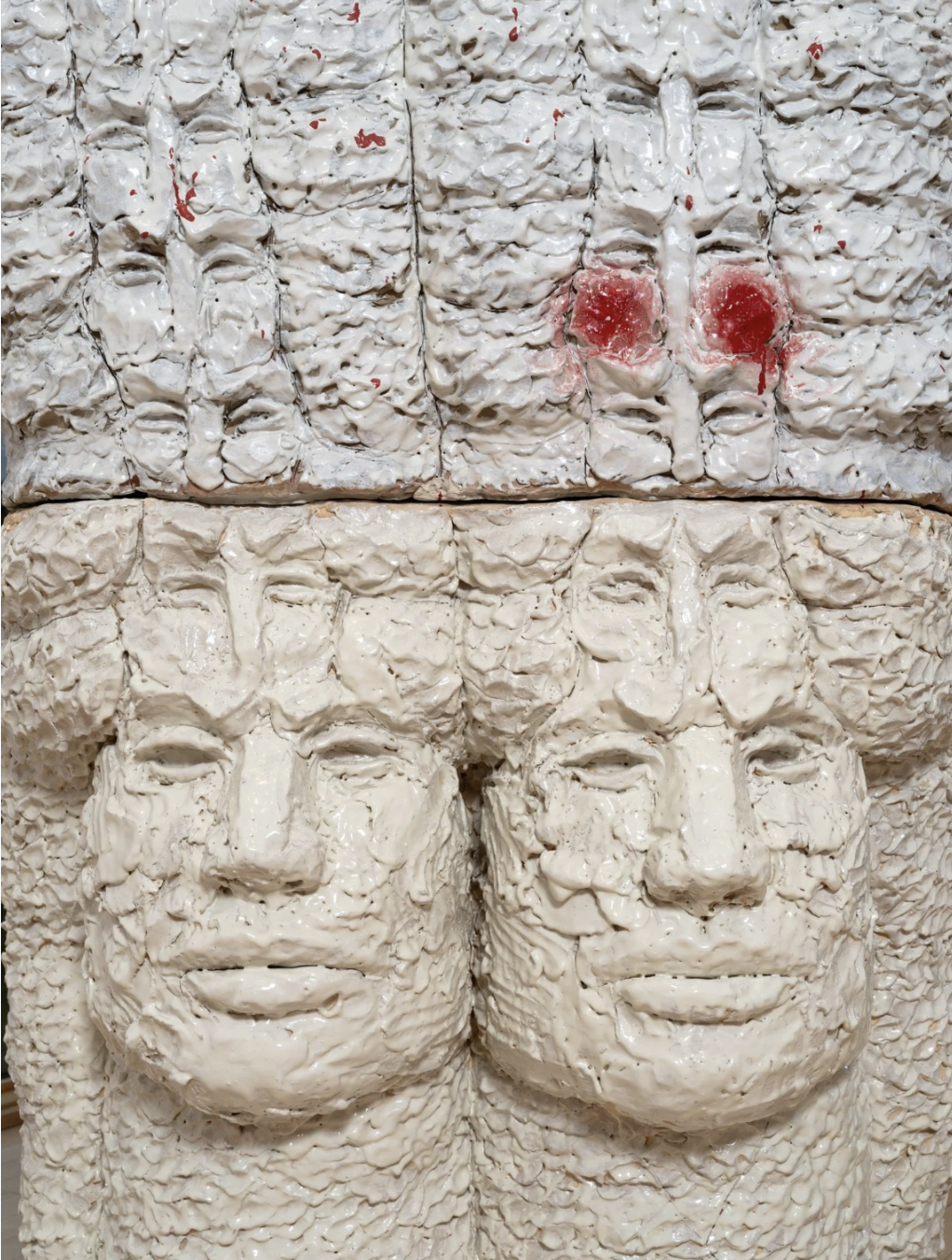
Raven Halfmoon, HASINAI (Caddo): Our People (detail), 2021, stoneware and glaze, 105 x 42 x 38 inches. Image courtesy of the artist.
In the work America’s Sweetheart, a new flag is raised. A tall woman leans forward, her body a stack of dripping stripes. Armless, she echoes goddess statues of Greek or Roman antiquity. Halfmoon’s new divinity acknowledges, but ultimately refuses, this lineage. Hers is a defiant priestess, dusted by ancient stars. Red sits at her hips, a potent root from which she draws her strength. Recontextualizing this Western iconography, its power is alchemized.
Halfmoon writes for the wall text: “The work in this show represents new flags, a new nation. But not new histories, just histories we haven't seen or heard”. Effaced histories take form in TASINAI (Caddo): Our People, a monolithic archive reminiscent of Mount Rushmore. A ruby-tipped column extends like a finger dipped in blood; the shaft is a stack of faces, the repetition of eyes and noses peering over each other. As color drips down the pillar, expressions shift, arching into anger, shame, and determination. Red charts a wound: the transmutation of generational trauma, its coalescence today. Looking at this sculpture feels like reading a transcript of feeling. Drawing a direct line to the past, it asserts Native livelihood in the present tense.
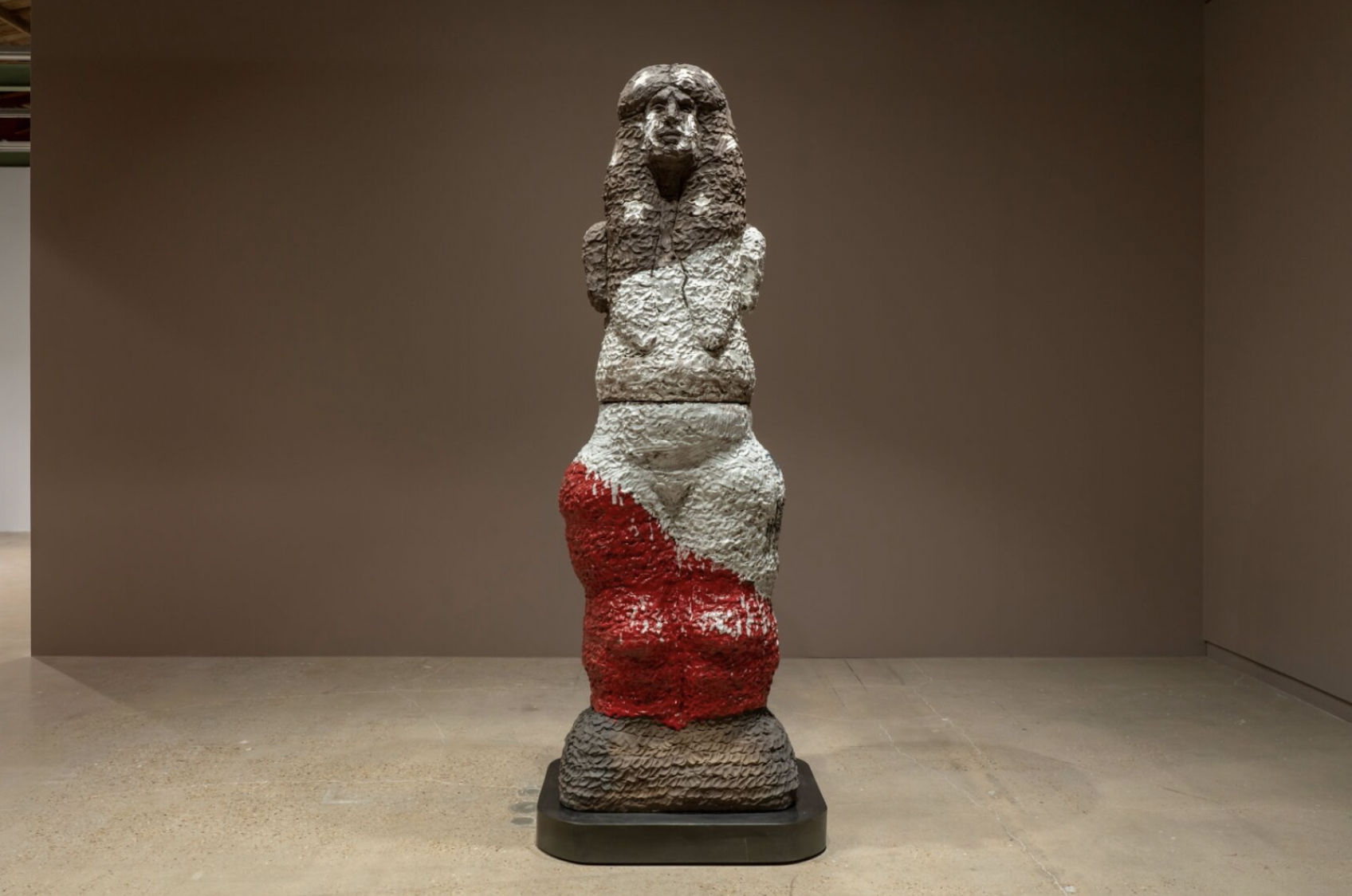
Raven Halfmoon, America’s Sweetheart, 2022, stoneware and glaze, 102 x 32 x 24 inches. Installation view, Raven Halfmoon: Flags of Our Mothers, The Contemporary Austin – Jones Center on Congress Avenue, 2024. Image courtesy The Contemporary Austin. Photograph by Alex Boeschenstein.
For Halfmoon, working with institutions not built for Indigenous voices, red has become a universal language of emotion, capable of reaching audiences across the limits of theory and cultural knowledge. The color is urgent, immediate, landing squarely in the most primal and compassionate parts of ourselves. In Halfmoon’s hands, red is a heart-to-heart communication, effective and unmistakable.
To speak in red is to speak from history as it folds and unfolds. In Flags of Our Mothers, it becomes the soil of a new nation, a fertile site of reckoning between the lives of Caddo women and the American project. Red has been a weapon and a wound, but here it transfigures both. Like the womb and the earth itself, Halfmoon’s work holds pain, but also the promise of continuity. As dawn recycles itself, blood calls to the loam which holds it: I am here.
Flags of Our Mothers was on view at the Ogden Museum of Southern Art through March 8, 2026. 925 Camp St, New Orleans, LA 70130.