
Monique Lorden’s Bodies of Space and Air
By Lara Schaberg
August 18, 2026
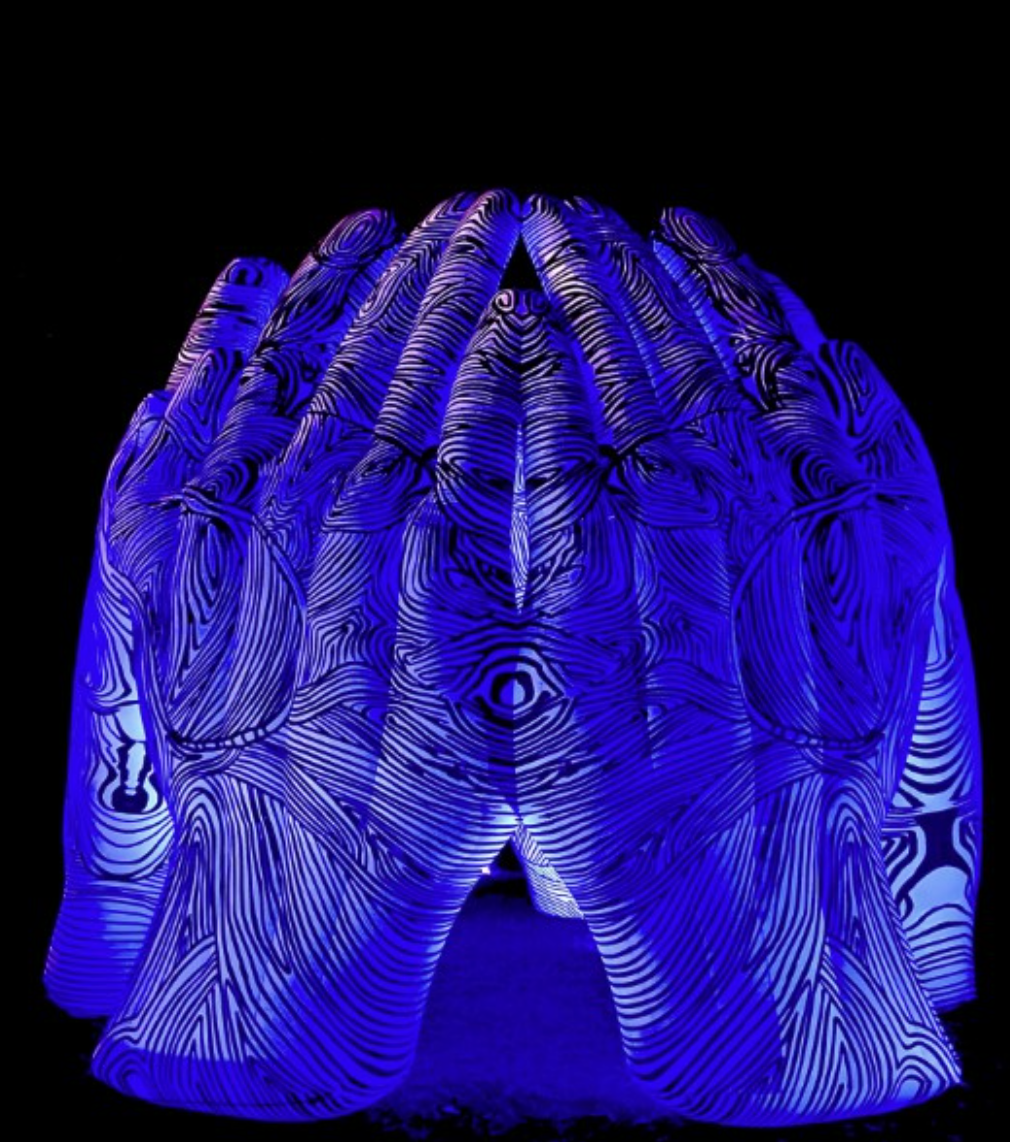
Monique Lorden, Carry Us Home, 2024, vinyl inflatable sculpture, 14 x 8 feet. Image courtesy of the artist.
Multimedia artist Monique Lorden’s public inflatable sculpture Carry Us Home (2024) details electric blue hands joined together. The placement evokes a feeling of reaching, textural lines reminiscent of fingerprints or tree rings. We are here to feel. “Our hands hold, heal, carry, protect, and build,” writes Lorden. The structure conjures a need to touch new futures.
Another work by Lorden, The Holding (2025), was on view at the group show YES Mama! at Merchant Hall in New Orleans in 2025. In a tranquil space, a soundscape composed by Lauren Fuller expands the already massive work. A female figure kneels in a high contrast palette of white and black — red floral shapes blooming around her. She is pregnant, eyes closed, with hands gracing her belly and face. You can hear a hum of breathing within the vinyl material — the inflatable piece both fragile to touch and overwhelming in size. “These are visions where play, scale, softness, and radical imagination invite us to reconsider what art can hold and how boldly it can breathe,” writes the artist.
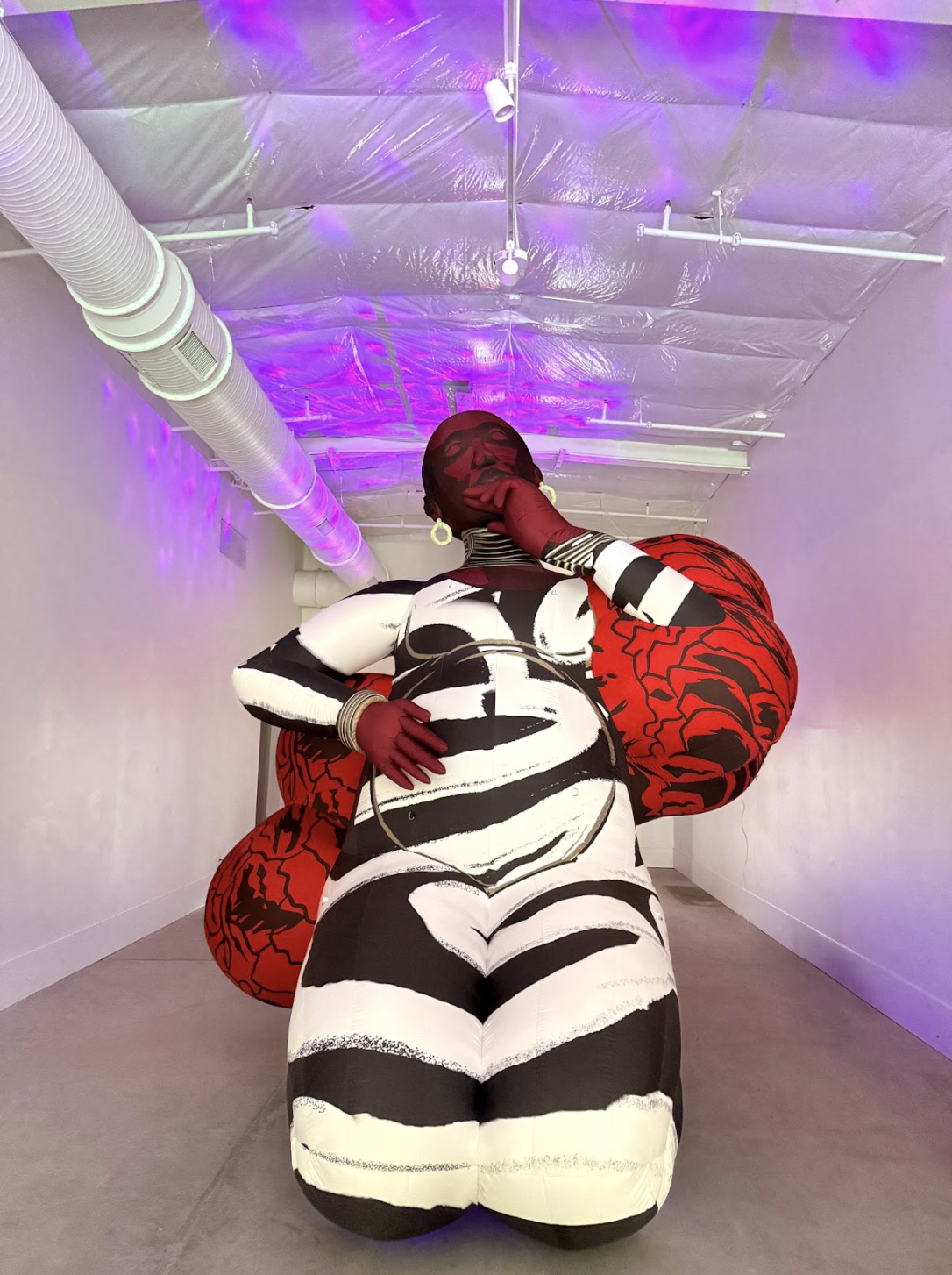
Monique Lorden, The Holding, 2025, vinyl, 14 x 8 feet. Image courtesy of the artist.
The work always starts as an emotive undercurrent, and Lorden’s initial sketches inform the concept as it transforms into another dimension. “Installing these works is a meticulous and intentionally slow process,” shares Lorden. “Their scale requires significant space larger than the sculptures themselves because the environment becomes part of the narrative. Placement is not simply logistical; it is a form of storytelling. I consider the pathways, the light, the air, and how the sculpture will breathe in the room. Anchoring and electricity must align precisely for the works to rise and settle correctly. The act of installation becomes an intimate collaboration with space, ensuring the sculpture’s presence is felt rather than simply placed.”
Lorden’s work references a colorful collision of pop art and pop culture while rooting firmly in the realm of feminist art. I think of Warhol’s 1966 Silver Clouds as well as Nick Cave’s 2019-2020 Augment that use the scale of inflatable balloons to comment on social practice and the structures holding a fragile world together. Warhol’s, Cave’s, and Lorden’s works are largely composed of air. How does air activate an in-between space? What is this liminality? These works seem to reference an ephemeral, atmospheric state between flux and formation. Silver Clouds, like The Holding, invites viewers to touch, walk through, and blur the line between audience and artwork, installation and activation. Cave’s massive assemblage of inflatable vinyl lawn ornaments was taken to the streets in a three mile “Joy Parade” in Boston, Massachusetts. Likewise, Lorden’s work is realized on the streets, both as inflatable sculpture and in the instance of her 1985Love Campaign, a movement to celebrate connection in a call for love, reflection, and resistance.
“The revolution will be rhythmical and shall not be flattened,” writes curator Virginia Vigliar. This echoes in the voluminous scale of Lorden’s practice and its radical ability to take up literal and metaphorical space. The art infuses the ground with care and inspires embodied structures of collectivity. These gateways of visual art convey her commitment to nurturing the landscapes of our interconnectivity.