
John Allyne: Printmaking in Motion
By Emily Alesandrini
August 18, 2026
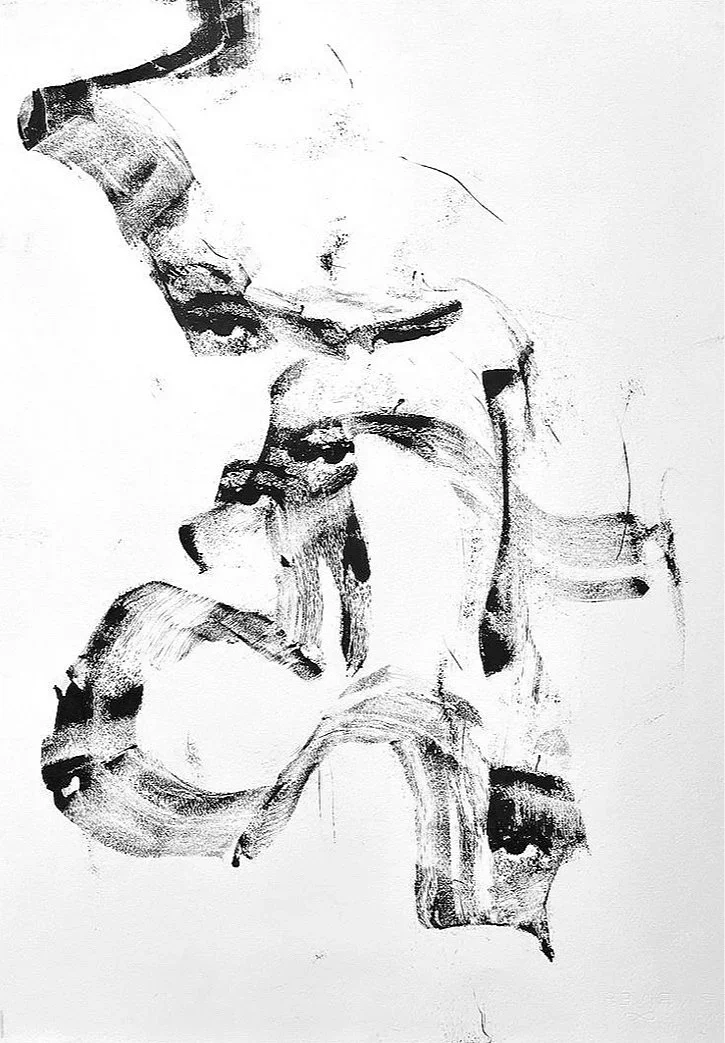
John Alleyne, These eyes tell no lies, 2021, silkscreen monotype on arches 88 paper, 24 x 19 inches. Image courtesy of the artist.
Barbados-born artist John Alleyne makes silkscreen prints all wrong. Conventional wisdom dictates makers pull the inked squeegee smoothly to create a crisp and cohesive image. Alleyne instead alters the path of his hands to produce a trail of his errant, improvised motions, blurring his subjects into obscure, abstracted, and aqueous figures. Ribbon-river strokes hint at a figure akin to something like graffiti or handwriting. In These eyes tell no lies (2021), a circuitous line winds a seeing eye here and there, its gaze holding the viewer’s before disappearing back into the inky trail. As is the case with so many of Alleyne’s works, multiple eyes invert the burden of perception, the gaze, back toward the viewer. What is inscrutable is also scrutinizing.
I read Alleyne’s movement across the page as a kind of echo of migration through Caribbean waters, tracing the path from places like Barbados to diasporas in New Orleans and beyond. The artist’s literal gestures in the printmaking process are reflected in the visual extension of his subjects. In Wave Runner (2021), a figure’s half-profile face stutters and stretches. If the blank page were a map, Alleyne pulls the figure across its terrain, hiding the head’s distinguishing details in the process. Perhaps, in his rule-breaking print praxis, Alleyne presents a language for depicting the experience of migration as a path of errantry. By doing things “incorrectly”, the artist demonstrates an alternative means of making, of depicting personhood and its movement without direct representation. Through Alleyne’s subjective motion and liquid material, the figure expands on paper while simultaneously resisting legibility. As with almost all of his work, the body is invoked without being depicted entirely or subjected to what scholar Saidiya Hartman calls, “the burden of representation.”
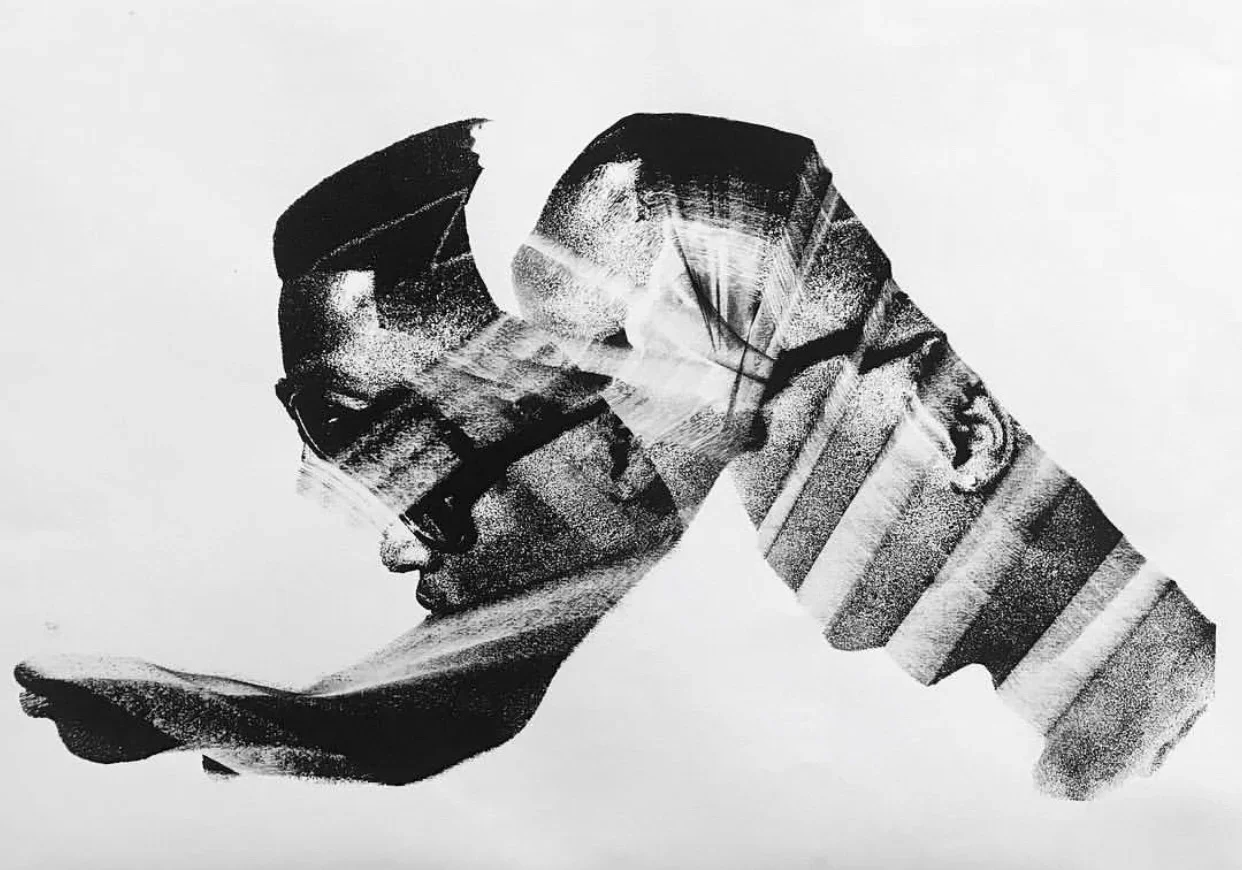
John Alleyne, Wave Runner, 2021, silkscreen monotype on arches 88 paper, 17 x 26 inches. Image courtesy of the artist.
By deviating from the norms of printmaking, Alleyne leaves the door open for new forms of experimental mark making. His compositions resonate with Franz Kline’s monochromatic Abstract Expressionist works, with David Hammons’s body print series, and with Adam Pendleton’s Black Dadaist collages. Additionally, I see a connection with Steffani Jemison’s minimalist glyphic paintings that engage Black vernacular traditions and coded communications of the twentieth century. All of these makers employ a monochromatic palette, often on a stark white ground, their dark ink writing something in between word and image.
Alleyne’s print works, along with other material experiments in painting and sculpture, were on view in a 2026 solo exhibition aptly titled Freeform at Antenna in New Orleans. Entering the gallery, I encountered the artist’s Pan-African Flag (Prototype) (2026), a rotating barbershop pole with green, black, and red stripes hanging on an entryway wall. In the early twentieth century, the Pan-African movement aimed to globally unite people of African descent, demand political independence for colonized African nations, and celebrate African culture outside of European standards of beauty and excellence. A Pan-African flag ostensibly represents many places simultaneously and perhaps also the movement (elected or forced) between those shores and borders.
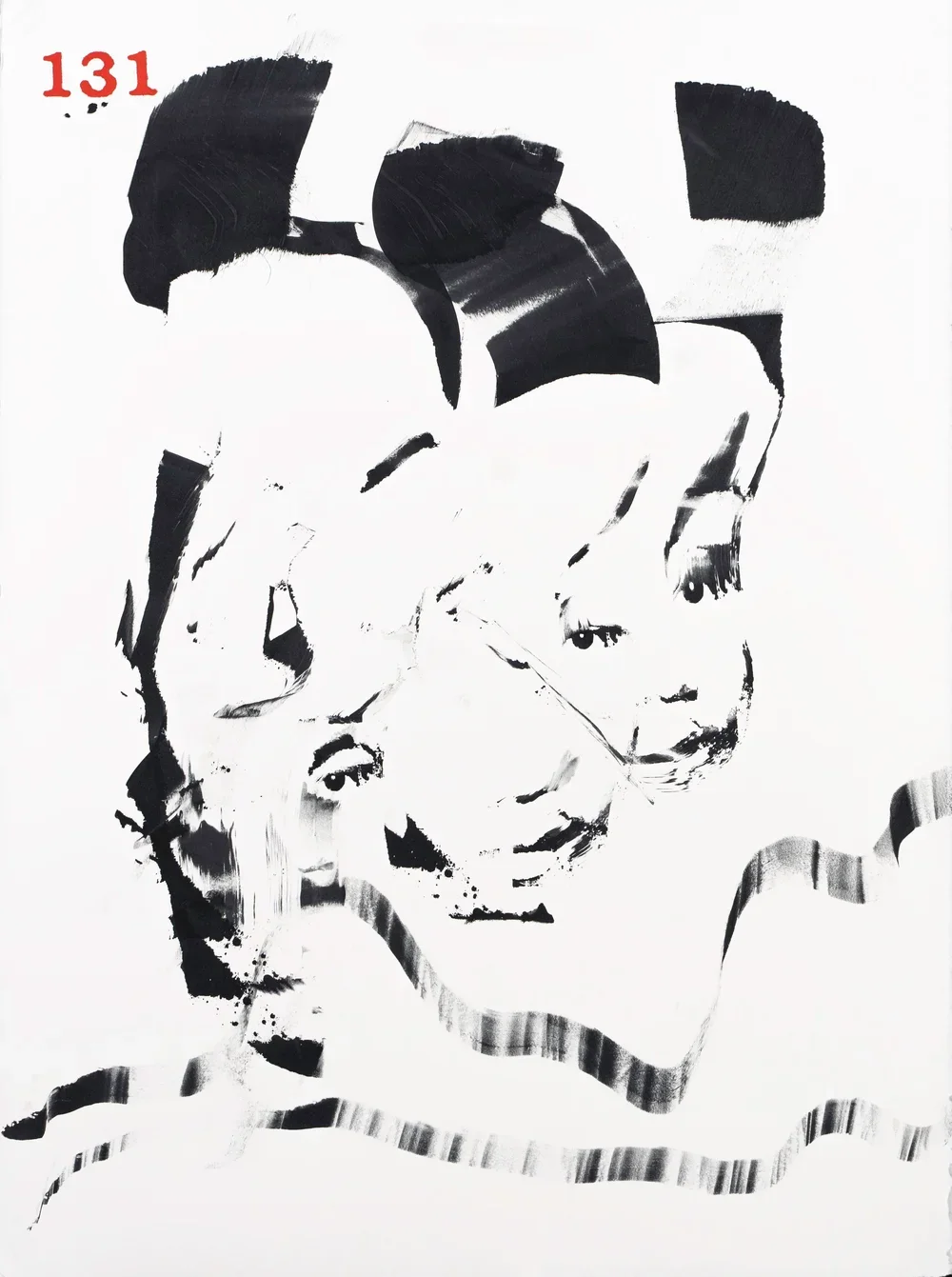
John Alleyne, Gathering without criticisms, or the critical eye, 2021, monotype on arches 88 paper, 30 x 24 inches. Image courtesy of the artist.
For several minutes, I watched the poll-flag spin, its motion kinetic, yet restricted, and constant. Rotating round and round, the stripes appear like coded ellipses that might be read to indicate a site of safety and care for the Black body. Alleyne sources his figural imagery from barbershop posters advertising various haircut styles, pictures he’s seen repeated in his native Barbados, as well as in diasporic communities in Brooklyn and Baton Rouge. Once on the body, the haircut just keeps moving, a copy of a copy and also entirely unique. In one of our recent studio visits, Alleyne referred to barbers as artists themselves and recalled organizing his own haircut as a public program at Baton Rouge Art Gallery during a 2021 solo exhibition, effectively transforming the art space into a barbershop. Another rule broken — galleries aren’t for haircuts. Or are they? Imprints of the artist’s locs appear throughout his works on paper. Given that these details index Alleyne’s own body, I read them as an alternative kind of signature or fingerprint, a woven printmaking tool he grows himself with ancestral DNA.
In his series Protective Dreadlock Stylz (2023 - ongoing), printed and collaged hair components obscure the faces of anonymous hairstyle models whose eyes remain uncovered. These quasi-portraits stare back from within bodily coverings that in many instances look like helmets, adornment of protection and safety. And yet they are hair and ink in motion. In the work, No. 4 (2023), two faces converge and overlap into a single subject with three eyes, their combined faces disappearing below the nose. The crown of the figures merges squeegee scrawl with imprints of the artist’s dreads, a confusion of mark, movement, and body. Are they twins with a third eye? An ancestor or a shadow self? I’m reminded here too of historical accounts during the transatlantic slave trade of messages braided or goods hidden in the hair of enslaved people. What more might we read from Alleyne’s mark making and rule breaking? If only I had more eyes.
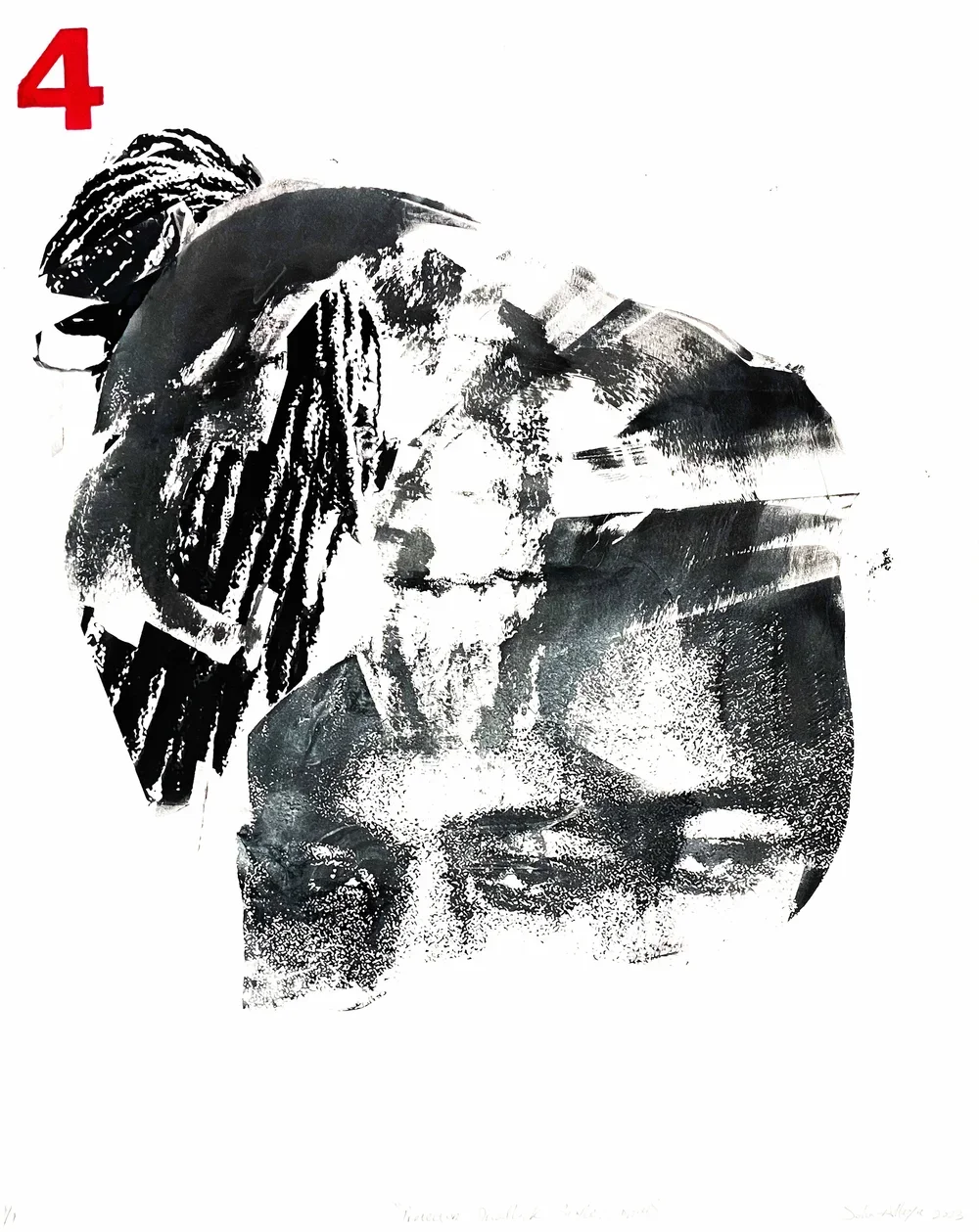
John Alleyne, No. 4, 2023, silkscreen monotype on paper, from the Protective Deadlock Stylz series, 22 x 36 inches. Image courtesy of the artist.
John Alleyne’s solo exhibition Freeform was on view from May 9 through June 27, 2026 at Antenna gallery, 3718 Saint Claude Avenue, New Orleans, LA 70117.
This article was supported by The Andy Warhol Foundation Arts Writers Grant.